


The International Air Transport Association’s (IATA) latest
long term passenger growth forecast expects global air passengers to
number 7bn by 2034 – double the 3.3bn who flew in 2014 double the 3.5bn
expected in 2015.
This assumes a a 3.8% average annual growth in demand using 2014 as
the baseline year. This is down by 0.4m on the previous 7.4bn forecast,
which was based on a higher 4.1% average annual growth rate. IATA says
this revised down forecast is based on projected negative developments
in the global economy – in particular anticipated slower economic growth
projections for China.
FIVE FASTEST INCREASING MARKETS…
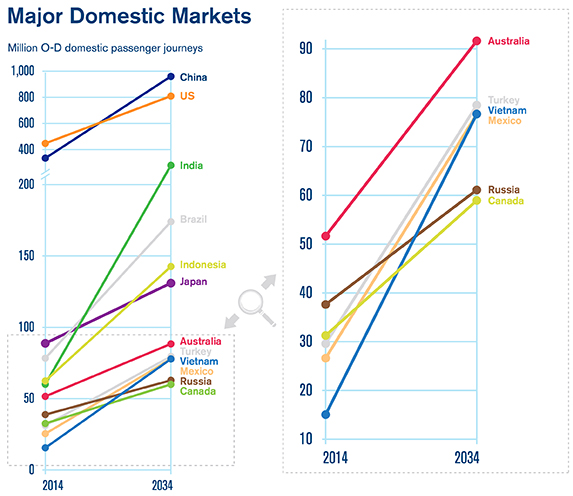
Nevertheless, it predicts that the five fastest-increasing markets in
terms of additional passengers per year over the forecast period will
be China (758m new passengers to total 1.196bn); the US (523m new
passengers to total 1.156bn); India (275m new pax to total 378m);
Indonesia (132m new pax to total 219m); and Brazil (104m new pax to
total 202m).
IATA also predicts that seven of the top ten fastest-growing markets
in percentage terms will be in Africa, with each market expected to grow
+7-8% each year on average over the next 20 years – so doubling in size
each decade. These countries are: Central African Republic; Ethiopia;
Malawi; Papua New Guinea; Rwanda; Serbia; Sierra Leone; Tanzania;
Uganda; and Vietnam.
Turning to routes, IATA predicts that Asian, South American and
African destinations will see the fastest growth, reflecting economic
and demographic growth in those markets. Indonesia-East Timor will be
the fastest growing route, at 13.9%, followed by India-Hong Kong
(10.4%); Within Honduras (10.3%); Within Pakistan (9.9%); and
UAE-Ethiopia (9.5%).

“Economic and political events over the last year have impacted some
of the fundamentals for growth. As a result, we expect some 400m fewer
people to be travelling in 2034 than we did at this time last year. Air
transport is a critical part of the global economy. And policy-makers
should take note of its sensitivity.
“The economic impact of 400m fewer travellers is significant. Each is
a lost opportunity to explore, create social and cultural value, and
generate economic and employment opportunities. It is important that we
don’t create additional headwinds with excessive taxation, onerous
regulation or infrastructure deficiencies,” he added.
VARYING PERFORMANCES BY BRIC NATIONS
IATA also points out that a sizable gulf has appeared between the
performance of air passenger markets in the BRIC economies (Brazil,
Russia, India and China). The airline association says China and India
are growing fast, with annual growth this year-to-date of 12.5% and
16.5% respectively. India has also bounced back from a subdued 2014, and
is seeing a strong increase in domestic frequencies.
While China’s growth rate has moderated, IATA adds that it is still
on course to add an additional 230m passenger journeys between 2014 and
2019. This is more than double the other three BRIC nations put
together. However, by contrast Brazil and Russia are clearly struggling.
IATA said: “Falling oil and other commodity prices are partly to
blame. Economic sanctions have also affected the Russian economy. It is
notable that airlines in Brazil pay some of the highest fuel charges in
the world; bringing the country’s fuel policy in line with global
standards would certainly be a boost for air transport.”
More open travel between the rest of the world and Cuba and Iran also
offers exciting possibilities for business, tourism and development as
diplomatic relations ‘warm’, says IATA. Of the two markets, Iran offers
the greater potential.

Although Cuba is the largest Caribbean country by population, passenger growth would be from a low base of 5m passengers today to around 13m by 2034, in the best-case scenario.
Iran, by contrast, already has a market of 12m passengers – mostly
domestic. If strong GDP growth is accompanied with a full normalization
of international relations and the end to sanctions, IATA believes that
the total size of the Iran market could be 43.6m passengers by 2034.
“There is a great deal of scope for economic development in Cuba and
Iran, and air transport can play an enormous role in that. Relative to
their economic development, the people of Iran and Cuba fly less than
the global average. In Iran, full integration in the global economy
could mean a difference in passenger growth of around 13m extra
travellers a year,” said IATA’s Tyler.
CHINA WILL BE BIGGEST MARKET BY 2029
As reported before, China is expected to overtake the US as the
world’s largest passenger market (defined by traffic to, from and
within) by 2029. In 2034 China will account for some 1.19bn passengers –
758m more than 2014 – with an average annual growth rate of 5.2%.
Traffic to, from and within the US, is expected to grow at an average
annual growth rate of 3.1%.
That will translate into 1.16bn passengers by 2034 (523m more than
2014). India will displace the UK as the third-largest market in 2026,
with Indonesia rising to number five in the global ranking. By contrast,
IATA predicts that Japan, Spain, Germany and France will all fall
relative to their competitors, while Italy is expected to drop out of
the top 10 and Brazil is expected to move up from tenth to seventh
place.
REGIONAL GROWTH HIGHLIGHTS
IATA adds that routes to, from and within Asia-Pacific are expected
to see an extra 1.8bn annual passengers by 2034, for an overall market
size of 2.9bn. In relative terms Asia Pacific is expected to increase
its size compared to other regions to 42% of global passenger traffic,
and its annual average growth rate of 4.9% is expected to become the
joint-highest with the Middle East.
Meanwhile, the North American region is predicted to grow by 3.3%
annually and in 2034 will carry a total of 1.4bn passengers, an
additional 649m a year. However, Europe will have the slowest growth
rate of 2.7%, although this will still represent an additional 591m
passengers a year with this market expected to total 1.4bn passengers.
Latin American markets will grow by 4.7%, serving a total of 605m
passengers. increasing by an extra 363m passengers a year compared to
today, while the Middle East is expected to grow strongly by 4.9% and an
extra 237m passengers a year on routes to, from and within the region
by 2034.
The UAE, Qatar and Saudi Arabia are all predicted to enjoy strong
growth of 5.6%, 4.8%, and 4.6% respectively, with the total market size
expected to expand to 383m passengers. By contrast, Africa will grow by
4.7% and by 2034 it is expected to see an extra 177m passengers a year
for a total market size of 294m passengers.
At present, IATA says that aviation is estimated to help sustain 58m
jobs globally and $2.4 trillion in economic activity. In 20 years’ time,
it is expected to support around 105m jobs and $6 trillion in GDP


0 comments:
Post a Comment